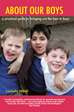
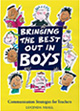
A really accessible, practical and useful handbook for parents and anyone who works with boys …not only explains clearly and insightfully what makes boys tick, but also provides a host of tips and strategies for bringing the best out in them.’
Tim Byford, Literacy Consultant
This book is sub-titled ‘communication strategies for teachers’, but much of the underlying psychology is just as useful for parents and home-educators. I found this book very informative; the author outlines the great differences between the way male and female brains work (yes, it's scientific fact!), why boys need different approaches to learning and how to make it enjoyable for them. The most pleasing feature for me was that the text is interspersed with actual case studies and examples to illustrate a point. The author has balanced the adult views well with relevant quotes from schoolchildren of all ages.
Sally Smith - Education Otherwise
Lucinda Neall's wise book takes on an issue that is now familiar to teachers, but which surfaced as a specific concern at the end of the 1980s. Within a four-year period the gap between boys' and girls' performance changed from rough equality to significant disparity, chiefly as a result of girls' improvement. Boys were being left behind. Since then, in many ways, we have made the problem worse with a curriculum that too often emphasises passive learning and defines success as purely academic.
Admirably, the writer outlines the context of male underachievement in a very crisp, readable way. There's no extended theorising or sociological treatises, but some fascinating light-touch research about parents' and teachers' expectations of boys and the influence of role models.
There is also an unexpected discussion of testosterone levels, quoting Steve Biddulph's theory of TNT (testosterone needing tuition). Testosterone levels peak at around 14 and affect the way the brain functions. There is an impact on written and verbal abilities; a rise in boisterous and competitive behaviour, and increased assertiveness.
The book gives us a useful summary of some of the biological differences between the genders, including (fashionably) the variations in the make-up of the brain. These differences may help to explain, for example, why the early years' concentration on reading and writing favours girls, whose connections between brain hemispheres make them more articulate and fluent.
Neall quickly gets stuck into her main agenda: not merely diagnosis, but practical measures which, she promises, "take no extra teaching time, can readily be incorporated into lessons and will reduce time on discipline in the future". That's quite a promise, but she delivers. She shows us the importance of building boys' self-esteem (though girls, of course, have the same need), through acknowledging their view of the world, showing them respect, and praising them.
The strength of the book lies in the linguistic models which show us how it works. According to Neall, here's how not to tell a boy off: "Stop asking silly questions." Instead, say: "You'd like to know how mountains are made, Jordan. That's an interesting question and we will be covering it in geography next year. But if you can't wait that long, come and find me at lunchtime and I'll lend you some books about it." Carefully avoiding Pink Floyd's "dark sarcasm of the classroom", this method enables the teacher to make a strong point, without a put-down, and gives the boy room for manoeuvre. Skilful teachers do it naturally.
Neall demonstrates how the language we use inevitably shapes the boys' responses. In particular, we need to teach them an emotional vocabulary, helping them to recognise and express how they feel by describing their feelings and making them legitimate, as in: "You practised so hard this term, you must be gutted that you are not on the team." The teacher is modelling talk and behaviour, rather than assuming the boy knows how to do it. There is similar advice on boundaries and discipline, how to avoid shouting and nagging, and using humour to motivate boys. This is one of the most interesting accounts available of an over-familiar issue, distinguished by its practical approach. Strongly recommended.